What's new in Vorarbeiter

It is almost a year since the switch to Vorarbeiter for building and publishing apps. We've made several improvements since then, and it's time to brag about them.
RunsOn
In the initial announcement, I mentioned we were using RunsOn, a just-in-time runner provisioning system, to build large apps such as Chromium. Since then, we have fully switched to RunsOn for all builds. Free GitHub runners available to open source projects are heavily overloaded and there are limits on how many concurrent builds can run at a time. With RunsOn, we can request an arbitrary number of threads, memory and disk space, for less than if we were to use paid GitHub runners.
We also rely more on spot instances, which are even cheaper than the usual on
demand machines. The downside is that jobs sometimes get interrupted. To avoid
spending too much time on retry ping-pong, builds retried with the special
bot, retry command use the on-demand instances from the get-go. The same
catch applies to large builds, which are unlikely to finish in time before spot
instances are reclaimed.
The cost breakdown since May 2025 is as follows:
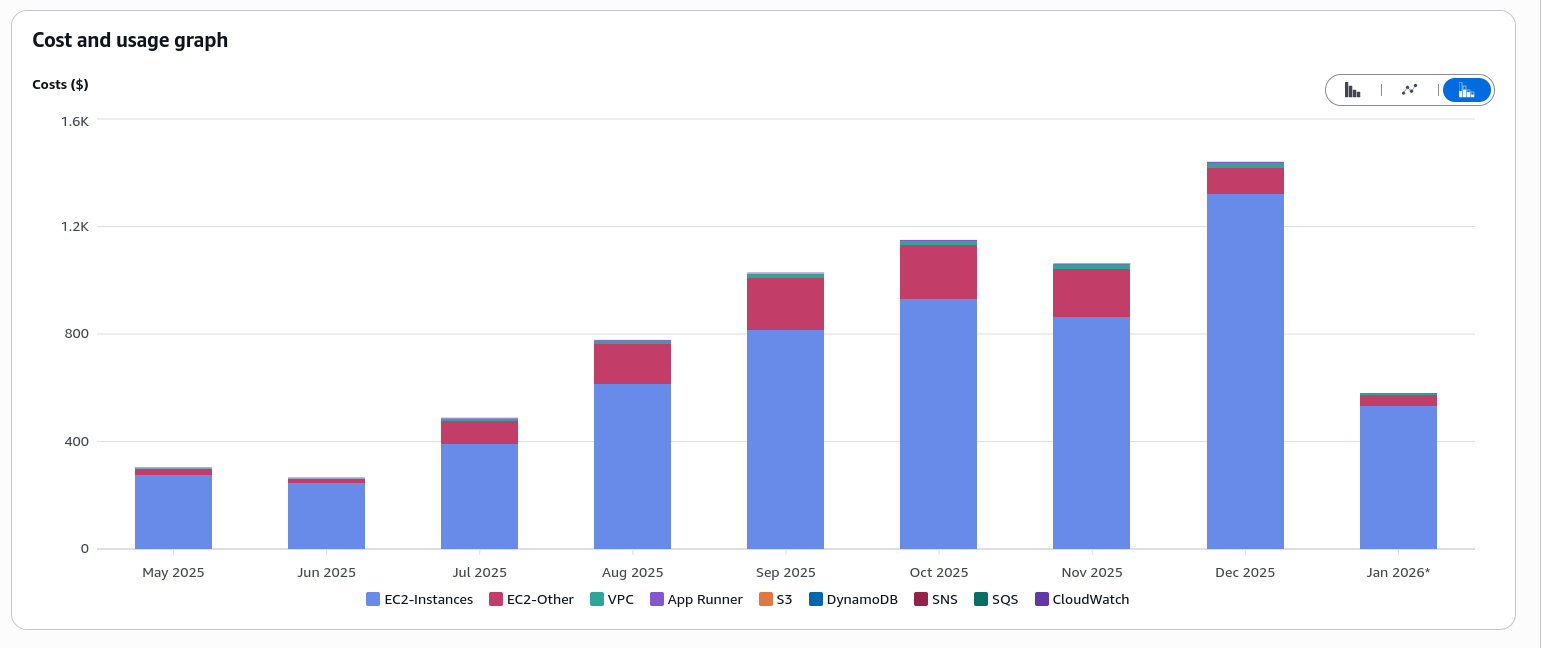
Once again, we are not actually paying for anything thanks to the AWS credits for open source projects program. Thank you RunsOn team and AWS for making this possible!
Caching
Vorarbeiter now supports caching downloads and ccache files between builds. Everything is an OCI image if you are feeling brave enough, and so we are storing the per-app cache with ORAS in GitHub Container Registry.
This is especially useful for cosmetic rebuilds and minor version bumps, where most of the source code remains the same. Your mileage may vary for anything more complex.
End-of-life without rebuilding
One of the Buildbot limitations was that it was difficult to retrofit pull requests marking apps as end-of-life without rebuilding them. Flat-manager itself exposes an API call for this since 2019 but we could not really use it, as apps had to be in a buildable state only to deprecate them.
Vorarbeiter will now detect that a PR modifies only the end-of-life keys in the
flathub.json file, skip test and regular builds, and directly use the
flat-manager API to republish the app with the EOL flag set post-merge.
Web UI
GitHub's UI isn't really built for a centralized repository building other repositories. My love-hate relationship with Buildbot made me want to have a similar dashboard for Vorarbeiter.
The new web UI uses PicoCSS and HTMX to provide a tidy table of recent builds. It is unlikely to be particularly interesting to end users, but kinkshaming is not nice, okay? I like to know what's being built and now you can too here.
Reproducible builds
We have started testing binary reproducibility of x86_64 builds targetting the stable repository. This is possible thanks to flathub-repro-checker, a tool doing the necessary legwork to recreate the build environment and compare the result of the rebuild with what is published on Flathub.
While these tests have been running for a while now, we have recently restarted them from scratch after enabling S3 storage for diffoscope artifacts. The current status is on the reproducible builds page.
Failures are not currently acted on. When we collect more results, we may start to surface them to app maintainers for investigation. We also don't test direct uploads at the moment.